
Syllabus Link
GS Paper III (Environment): Directly links to Environmental Pollution and Degradation, Conservation, and Disaster Management (Hazardous waste).
GS Paper III (Economy): Critical for the Blue Economy (fisheries, marine resources) and Circular Economy (resource recovery).
Prelims: High probability of questions on E-Waste (Management) Rules, 2022, EPR framework, Microplastics types (primary vs. secondary), and specific pollution indices.
Essay: Sustainable Development vs. Consumerism; “The hidden cost of the Digital Revolution.”
The News Context and Data Analysis
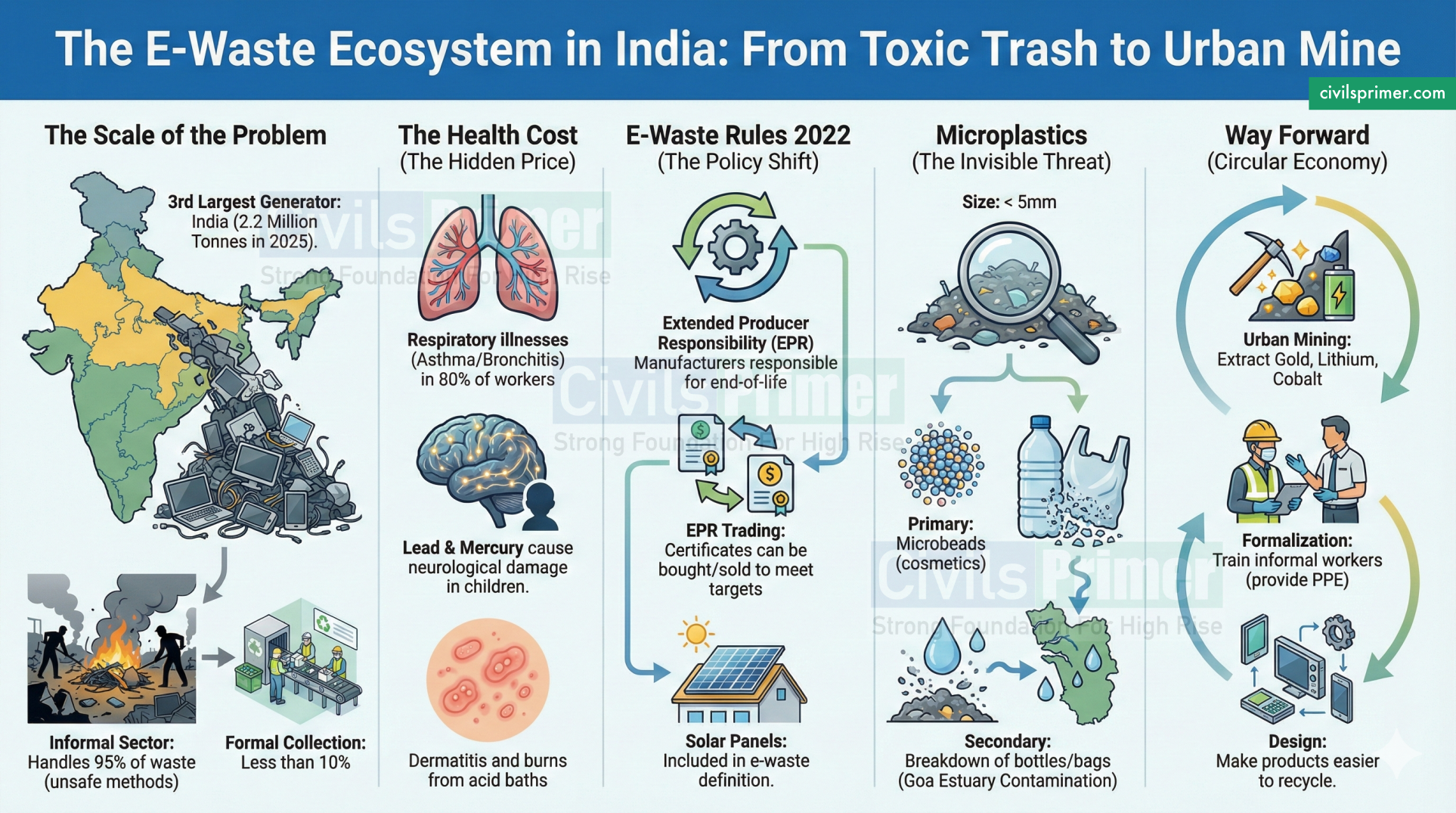
E-Waste Explosion: India has solidified its position as the third-largest e-waste generator globally (after China and the US), generating an estimated 2.2 million tonnes in 2025. This surge is driven by rapid urbanization, digitalization, and shrinking device lifespans.
Microplastic Crisis: A 2025 study by CSIR-National Institute of Oceanography (NIO) found microplastics in commercially important fish (like Anchovies and Catfish) in the Goa estuary. This confirms that plastic pollution has entered the marine food web, posing a direct threat to human health and the Blue Economy.
Core Concepts & Historical Evolution
| Concept | Definition & Basics |
| E-Waste (WEEE) | Discarded electronic/electrical equipment (phones, laptops, fridges). Contains Precious Metals (Gold, Silver, Copper) and Hazardous Toxins (Lead, Mercury, Cadmium, BFRs). |
| Microplastics | Plastic particles < 5mm. Primary: Intentionally small (microbeads in cosmetics). Secondary: Result of larger plastics breaking down (fishing nets, bottles). |
| Blue Economy | Sustainable use of ocean resources for economic growth. Pollution threatens this by contaminating fish stocks and degrading tourism. |
| Circular Economy | shifting from “Take-Make-Dispose” to “Reduce-Reuse-Recycle,” keeping materials in use for as long as possible. |
Constitutional, Legal & Institutional Framework
A. E-Waste (Management) Rules, 2022 (Key Features)
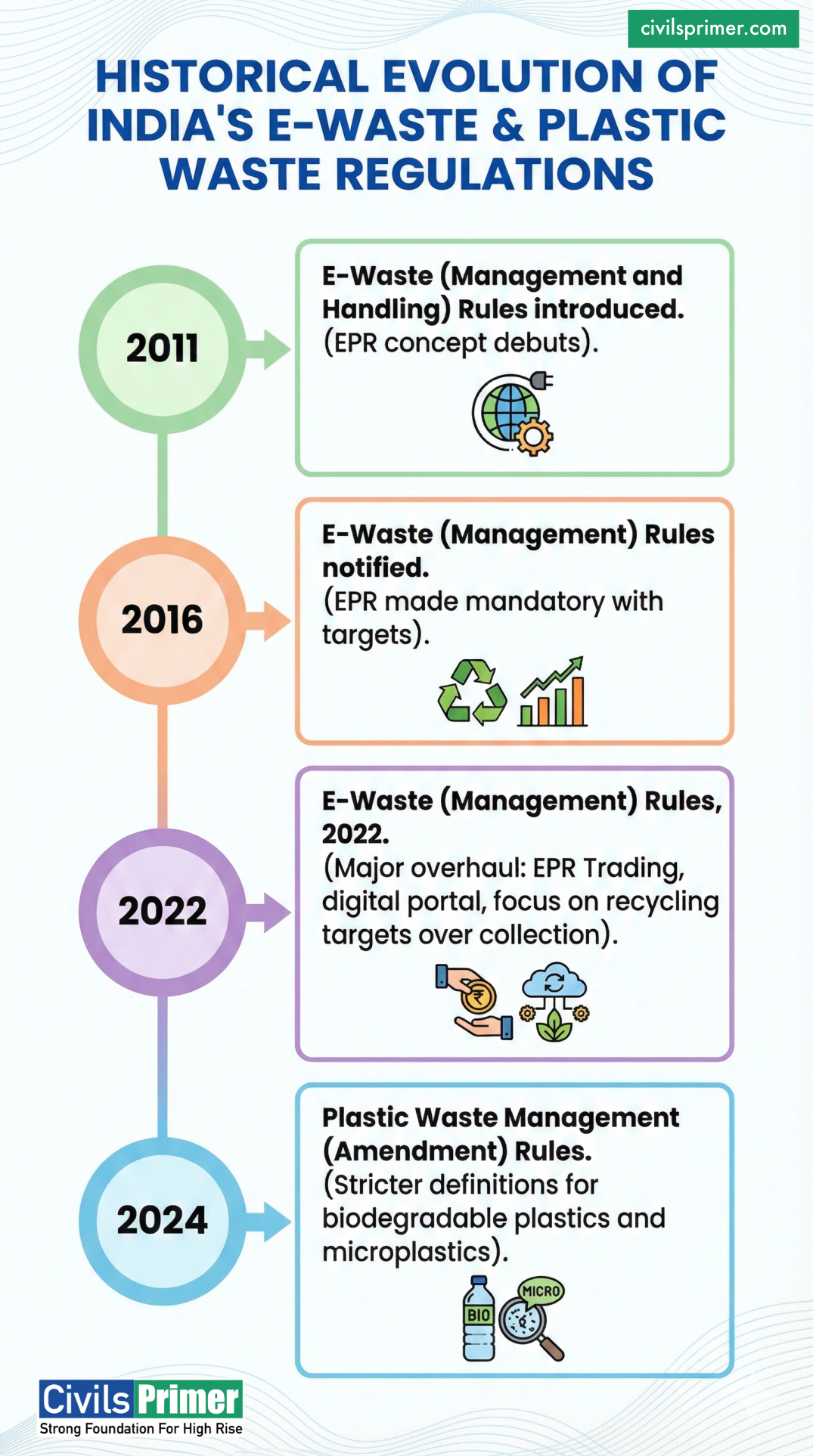
- Extended Producer Responsibility (EPR): Producers (manufacturers/importers) have mandatory targets to recycle a percentage of their sales volume from previous years.
- EPR Certificates: A market-based mechanism where recyclers generate certificates for processed waste, which producers buy to meet targets (similar to Carbon Credits).
- Role of CPCB: The Central Pollution Control Board manages the online portal where all stakeholders (Producers, Recyclers, Refurbishers) must register.
- Restricted Hazardous Substances (RoHS): Limits the use of lead, mercury, and cadmium in new electronics to make recycling safer.
B. Institutional Roles
- MoEFCC: Policy formulation and notification of rules.
- CPCB: Regulation, audit, and management of the EPR Portal.
- SPCBs (State Boards): Ground-level monitoring and granting “Consent to Operate” to recycling plants.
- Urban Local Bodies (ULBs): Responsible for orphan products (waste where the producer is untraceable).
Case Studies: The Good, The Bad, and The Ecological
1. The Positive Model: Attero Recycling (Formal Sector Success)
- What Happened: Attero, an Indian cleantech company, uses proprietary technology to extract 98% of precious metals (Gold, Lithium, Cobalt) from e-waste.
- Why it Matters: It proves that Urban Mining is profitable and sustainable. They partner with global brands (Samsung, LG) to fulfill EPR targets transparently.
- Lesson: Technology + Formalization = Resource Security (reducing import dependence for critical minerals).
2. The Negative Reality: Seelampur & Moradabad (Informal Hazards)
- What Happened: These hubs process ~80-90% of India’s e-waste illegally. Workers use acid baths (to extract gold) and open burning (to get copper).
- Why it Matters: 2025 reports indicate severe respiratory issues and skin diseases in workers. Heavy metals leach into the Ramganga river (Moradabad) and groundwater.
- Lesson: Laws exist, but enforcement is weak. The informal sector offers higher prices for scrap, diverting waste away from formal recyclers.
3. The Ecological Warning: Microplastics in Goa (Blue Economy Threat)
- What Happened: CSIR-NIO found microplastics in the gastrointestinal tracts of fish in the Mandovi-Zuari estuary.
- Why it Matters: Bio-accumulation means these toxins move up the food chain to humans. It threatens Goa’s fisheries economy (exports and tourism).
- Lesson: Waste management on land directly impacts the ocean (Ridge-to-Reef impact).
Issues, Challenges & Gaps
- Informal Sector Dominance: 90% of e-waste is still handled by the informal sector (Kabadiwalas) because they pay consumers for waste, whereas formal recyclers often charge for pickup.
- Infrastructure Deficit: India lacks adequate high-tech refining capacity for extracting rare earth elements (Lithium, Neodymium).
- Consumer Apathy: Lack of awareness about “responsible disposal.” Most users hoard old devices or sell them to local scrap dealers for quick cash.
- Data Leakage: Informal processing often leads to data theft from old hard drives, a dimension often ignored in environmental debates.
- Microplastic Filters: Wastewater Treatment Plants (STPs) in India are not designed to filter out microfibers from clothes or microbeads, releasing them into rivers.
- “Greenwashing” via EPR: There are concerns about fake EPR certificates being generated without actual recycling taking place on the ground.
Way Forward & Visionary Recommendations
- “Hub and Spoke” Model: Integrate the informal sector (as collectors/spokes) with the formal sector (as processors/hubs). Train kabadiwalas and give them incentives to funnel waste to certified recyclers.
- Design for Recycling (DfR): Mandate manufacturers to design products that are easy to dismantle and repair (Right to Repair movement).
- Digital Product Passports: Use Blockchain to track a product from “cradle to grave,” ensuring the EPR certificate matches a real recycled device.
- Blue Economy Safeguards: Install microplastic filters in washing machines (like in France) and upgrade STPs to tertiary treatment levels.
- Urban Mining Policy: Recognize e-waste not as “waste” but as a strategic resource for Critical Minerals (Lithium, Cobalt) needed for India’s EV transition.
UPSC Mains & Prelims Questions Mapping
Prelims Revision Facts
1. E-Waste Rank: India is the 3rd largest generator of e-waste globally (after China and USA).
2. E-Waste Rules 2022: Introduced EPR Certificate trading. Management includes solar photo-voltaic modules/panels/cells.
3. Basel Convention: Controls transboundary movements of hazardous wastes and their disposal.
4. Microplastics: Defined as plastic particles < 5 mm. Primary (microbeads) vs. Secondary (broken down fragments).
5. Prussian Blue Capsules: Used to treat internal contamination with radioactive cesium or thallium (Context: India gifted these to Indonesia).
6. Global E-waste Statistics Partnership (GESP): Initiative by UNU and ITU.
7. Lead Poisoning: Associated with e-waste; impairs brain development in children and causes neurological damage .
UPSC Mains Answer Writing
Mains Mock Q1.: “India’s digital leap cannot be allowed to create a toxic legacy.” Discuss the challenges in e-waste management in India and evaluate the effectiveness of the Extended Producer Responsibility (EPR) framework. (15 Marks, 250 Words)
Answer Structure Guide
- Introduction: Cite the 2.2 million tonnes generation stat (3rd largest globally). Define E-waste.
- Body Paragraph 1 (The Challenge): Discuss the dominance of the informal sector (95%) and the health hazards (lead, mercury). Mention the “collection gap” (<10% formal collection).
- Body Paragraph 2 (EPR Evaluation): Explain EPR under 2022 Rules.
- Success: Created a market for recycling certificates.
- Failure: “Paper trading” of credits, leakage of materials, lack of traceability.
- Body Paragraph 3 (Microplastics): Briefly link improper disposal to secondary microplastics (Goa case study).
- Way Forward: Suggest formalizing the informal sector (training, safety), better auditing of EPR, and consumer awareness.
- Conclusion: Connect to the vision of a Circular Economy and “Urban Mining” to secure critical minerals for Atmanirbhar Bharat.
Mains Mock Q2: “The surge in e-waste is both a toxic threat and a resource opportunity. Discuss this statement in light of the 2022 Management Rules and the concept of Circular Economy.”
Answer Structure Hint
- Introduction: Cite the 2.2 Million Tonnes data.
- Body
- Threat/Challenges: Seelampur case study (Health/Environment).
- Opportunity: Attero case study (Urban Mining/Critical Minerals).
- Role of Rules: EPR targets, formalization.
- Conclusion: Need to bridge the gap between informal collection and formal recycling.