
Syllabus Link
GS I: Distribution of key natural resources (Water); Geophysical phenomena (Earthquakes, GLOFs).
GS II: India and its neighborhood (Indus Waters Treaty); Government policies (Hydro Policy).
GS III: Infrastructure (Energy); Environmental Impact Assessment (EIA); Disaster Management (Dam failures).
Relevance for UPSC Civil Services Exam
- Why this matters: This topic is a classic “interlinkage” area, connecting Geography (river systems, seismic zones), International Relations (Indus Waters Treaty, China border infrastructure), Economy (energy security, infrastructure investment), and Environment (EIA, biodiversity, climate change).
- Trend: UPSC has increasingly focused on “Hill Area Development” and the “Water-Energy-Food Nexus” in recent Mains papers (e.g., Joshimath crisis, Himalayan eco-fragility).
Core Concepts & Background
Definition & Basics
- Hydroelectric Project (HEP) Types:
- Storage (Reservoir) Dams: Impound water in a large reservoir (e.g., Tehri, Bhakra). Can control flow for irrigation/flood control but have high environmental footprint.
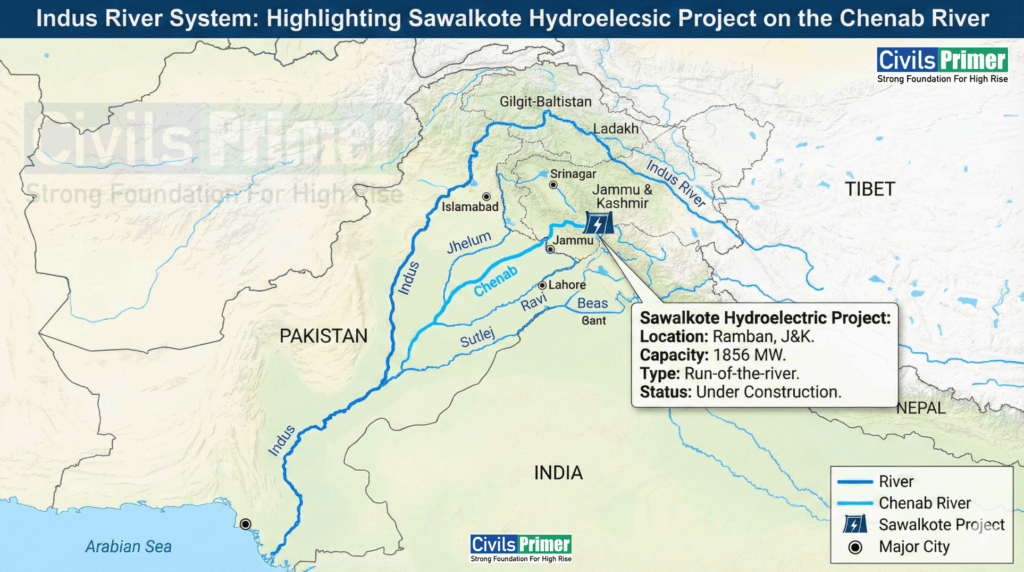
- Run-of-the-River (RoR) Projects: Use the natural flow of the river with minimal storage (pondage). Sawalkote and Oju are technically RoR but involve significant barrages/dams, blurring the lines.
- Installed Capacity Definition:
- Small Hydro: < 25 MW (Managed by Ministry of New & Renewable Energy).
- Large Hydro: > 25 MW (Managed by Ministry of Power; now classified as “Renewable Energy” to boost investment).
Historical Context and Background
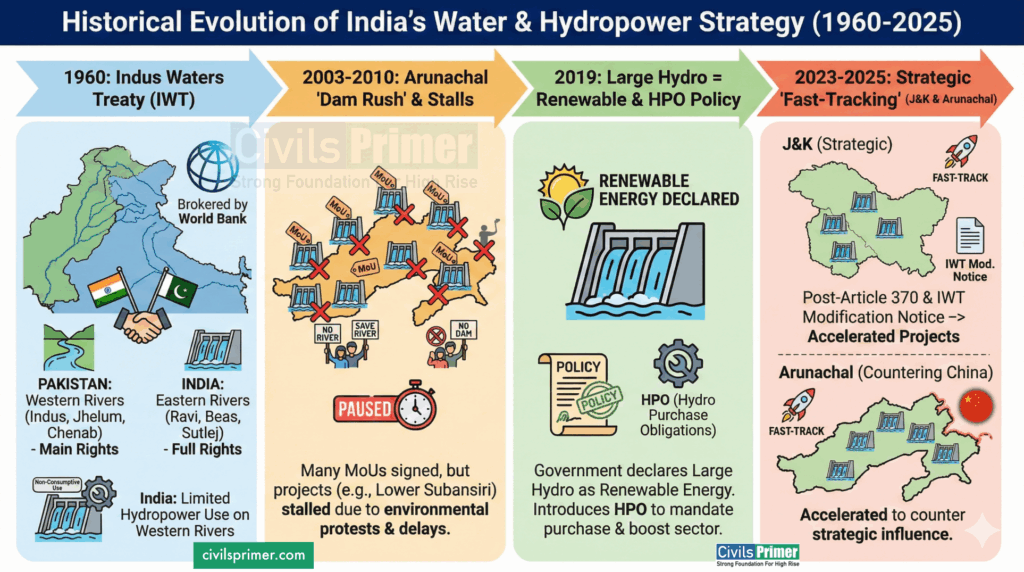
- 1960: Signing of Indus Waters Treaty (IWT) between India and Pakistan (brokered by World Bank). Gave India rights over Eastern Rivers (Ravi, Beas, Sutlej) and Pakistan rights over Western Rivers (Indus, Jhelum, Chenab), with India allowed limited “non-consumptive” use (hydropower) on Western rivers.
- 2003-2010: The “Dam Rush” in Arunachal Pradesh; many MoUs signed but stalled due to environmental protests (e.g., Lower Subansiri).
- 2019: India declares Large Hydro as “Renewable Energy” and introduces Hydro Purchase Obligations (HPO).
- 2023-2025: Strategic “Fast-Tracking” of projects in J&K (post-Article 370 & IWT modification notice) and Arunachal (countering China).
Deep Dive: The Projects in News
A. Sawalkote Hydroelectric Project (Chenab River, J&K)
- The Context: A massive 1,856 MW project in Ramban district.
- Strategic Shift: India recently issued a notice to modify the IWT. In this climate, “fast-tracking” Sawalkote is seen as India asserting its full rights to utilize the Western Rivers’ potential, which it had historically under-utilized to maintain good relations.
- Controversy: Pakistan objects to the design, claiming it violates IWT technical criteria (regarding pondage and spillway). India argues the design is compliant and necessary for energy security.
- Environmental Risk: Located in a seismically active zone; involves massive excavation in the fragile Pir Panjal range.
B. Oju Hydroelectric Project (Subansiri River, Arunachal Pradesh)
- The Context: A 2,220 MW project in Upper Subansiri district.
- China Factor: Located close to the Line of Actual Control (LAC). It acts as a strategic “First User” rights assertion against China’s massive dam-building upstream on the Yarlung Tsangpo (Brahmaputra).
- Environmental Risk:
- GLOF (Glacial Lake Outburst Flood): The project recently received clearance conditionally—developers must simulate GLOF scenarios.
- Seismic Zone V: Highest earthquake risk zone.
- Biodiversity: Submergence of pristine forests in the Eastern Himalayas.

Constitutional, Legal & Institutional Framework
| Dimension | Key Provisions / Bodies |
| Constitutional | Entry 17 (State List): Water (Water supplies, irrigation, canals). Entry 56 (Union List): Regulation and development of inter-state rivers/valleys (if declared by Parliament). Entry 38 (Concurrent List): Electricity. Article 262: Adjudication of disputes relating to waters of inter-state rivers. |
| Legal Acts | Inter-State River Water Disputes Act, 1956: Framework for tribunals. Electricity Act, 2003: Governs generation, transmission, and trading. Draft Electricity (Amendment) Bill, 2025: Proposes stricter Hydro Purchase Obligations (HPO) and penalties for non-compliance. |
| Institutions | CWC (Central Water Commission): Technical appraisal (hydrology, design). CEA (Central Electricity Authority): Techno-economic clearance. MoEFCC: Environmental & Forest Clearance (via Expert Appraisal Committee – EAC). |
Case Studies: Lessons Learned
Case Study 1: The Cautionary Tale – Teesta III (Sikkim)
- What Happened: In Oct 2023, the South Lhonak Lake burst (GLOF), washing away the 1200 MW Teesta III dam.
- Why it Matters: It was a modern dam, yet it failed due to a lack of Early Warning Systems (EWS) and failure to open spillway gates in time.
- Lesson: “Run-of-river” dams are not immune to GLOFs. Reliance on historical data is fatal in a climate-change era; real-time monitoring of upstream glacial lakes is non-negotiable.
Case Study 2: The Sustainable Model – Teesta V (Sikkim)
- What Happened: Rated as an example of “International Good Practice” by the International Hydropower Association (IHA).
- Why it Matters: Managed sediment effectively and maintained minimum ecological flow (e-flow) downstream, minimizing harm to aquatic life.
- Lesson: Sustainable hydro is possible with rigorous adherence to Hydropower Sustainability Assessment Protocols (HSAP).
Issues & Challenges (High Impact for UPSC Mains)
- Geological Volatility (The “Himalayan Blunder”): The Himalayas are young, fold mountains. Building mega-structures in Seismic Zone IV & V (like Oju) creates a “ticking time bomb” (Reservoir Induced Seismicity).
- The GLOF Threat: As per ISRO, hundreds of glacial lakes in the Himalayas are expanding. A dam acts as a barrier during a GLOF, amplifying the disaster downstream (as seen in Teesta III).
- Financial Viability: Hydro projects face massive cost overruns (e.g., Sawalkote’s cost ballooned to ₹31,000+ Cr). Solar/Wind tariffs are now ₹2-3/unit, while new Hydro is ₹5-6/unit, making it less competitive without subsidies.
- Cumulative Impact Ignored: EIAs are often done “project-by-project” (e.g., assessing Oju in isolation) rather than a Basin-Wide Cumulative Impact Assessment (CIA), ignoring how multiple dams choke a river system.
- Social Displacement: Displacement of indigenous tribes (e.g., Idu Mishmi in Arunachal) leads to loss of cultural heritage and livelihood, often sparking long-standing protests (e.g., Lower Subansiri stalled for years).
- Transboundary Conflicts:
- With Pakistan: Sawalkote adds tension to the fragile IWT.
- With China: Dams in Arunachal are a strategic “water race,” but lack of data-sharing agreements makes downstream India vulnerable to sudden releases from China.
Way Forward & Visionary Recommendations
- Institutional Reform: Move from “Project-centric” EIAs to “River Basin Carrying Capacity Studies”. No new clearance until the basin’s total capacity is scientifically defined.
- Safety First: Mandate Dam Safety Act, 2021 compliance strictly. Every Himalayan dam must have a Glacial Lake Monitoring System linked to an automated downstream alarm system.
- Strategic vs. Commercial: Treat border dams (like Oju) as “Strategic Assets” funded by Defense/Home Ministry budgets, rather than burdening the power tariff, to ensure financial viability.
- Local Stake: Implement a “Benefit Sharing Mode” where local communities become shareholders in the project (dividend from revenue), not just recipients of one-time compensation.
- Diplomatic Offense: Renegotiate/Modernize the Indus Waters Treaty to account for climate change and run-of-river technologies, rather than operating on 1960s assumptions.
UPSC Exam Toolkit – Prelims and Mains
Prelims: Crisp Facts List
- Sawalkote Project: Chenab River, J&K, Run-of-River, 1856 MW.
- Oju Project: Subansiri River (Tributary of Brahmaputra), Arunachal Pradesh.
- Indus Waters Treaty (1960): Brokered by World Bank. India = Ravi, Beas, Sutlej. Pakistan = Indus, Jhelum, Chenab.
- Hydro Purchase Obligation (HPO): Part of Non-Solar RPO. Applies to large hydro (>25MW) commissioned after March 8, 2019.
- Seismic Zones: Most of NE India and J&K fall in Zone V (Very High Damage Risk).
- Teesta III: Collapsed due to GLOF from South Lhonak Lake.
Mains: Question Mapping
- Q1 (GS III – Disaster Management): “The recent failure of the Teesta III dam highlights the vulnerability of critical infrastructure in the Himalayas. Discuss the concept of Glacial Lake Outburst Floods (GLOFs) and suggest measures to climate-proof hydropower projects.”
- Q2 (GS II – International Relations): “Hydro-diplomacy is becoming a central pillar of India’s strategic neighborhood policy. Analyze the strategic implications of the Sawalkote and Oju projects in the context of the Indus Waters Treaty and the China border dispute.”
- Q3 (GS III – Environment Vs. Development): “Can India’s ‘Decade of Hydropower’ coexist with the ecological fragility of the Himalayas? Critically evaluate the need for a basin-wide Cumulative Impact Assessment approach.”
Likely MCQ Trap
- Trap: “Sawalkote is a storage dam built on the Ravi river.”
- Correction: It is a Run-of-River project on the Chenab.
- Trap: “Large Hydropower projects are not counted as Renewable Energy in India.”
- Correction: Since 2019, Large Hydro (>25MW) IS classified as Renewable Energy.